Exposure
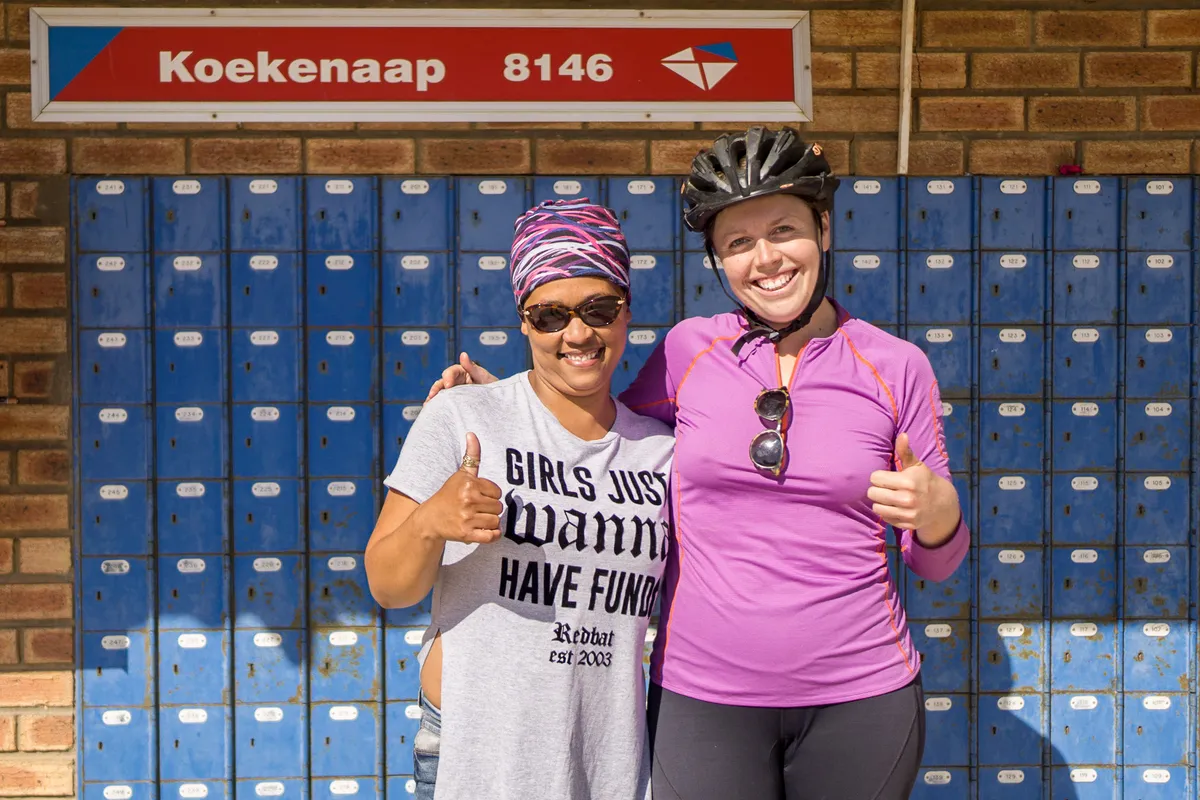
I see new similarities and differences in the women around me when I stop wearing a bra while bike travelling in southern Africa.
In the wet heat of Maputo, Mozambique, it felt fantastic to never wear a bra. All of me was free to catch whatever breeze the coastal capital offered. But in public, this only felt acceptable in my non-cycling clothes, the ones that obscure. Neither my tunic with dense embroidery nor my loose, patterned dress nor my plaid button-up show more than a suggestion of the nipples that—obviously—lie beneath.
After ten days, we packed up to leave Maputo to cycle to Swaziland, the petite hilly nation nearly surrounded by South Africa. I started changing into my single cycling outfit automatically. It's a uniform of leggings, a moisture-wicking t-shirt and a sports bra (weather gear aside). But as I put them on, it hit me that Mozambique wouldn’t be cooler outside Maputo. It would probably just get hotter the farther we rode from the shady boulevards arranging the upscale neighbourhood we’d planted ourselves in, thickening from chocolate croissants and sitting.
I didn’t want the bra sticking to my back as the sun beat down on me hunched over the handlebars—simple. So I didn’t put it on and haven’t since, despite my cycling top being the most revealing top I own.
Maputo is far from the first warm city we’ve ridden from. In its attitudes towards nipples it seemed unremarkable, its women wearing bras just as much as any other cosmopolitan, urban place. It was just hot, and I’d racked up so much time without one, that this part of my uniform now felt a little bit optional. The door was open, if only a crack. Not wearing it now seemed like both an intriguing and embarrassing experiment, instead of just embarrassing.
Without their support network, my boobs now dealt with the full force of riding a heavy bicycle without suspension on rough roads. I didn’t ease their transition. After a few days following the smooth tar into Swaziland, we often chose sandy, rocky routes to snake around the country. I still made poor line choices when ruts and corrugations appeared, still rode jerkily and indecisively. Once, I rode slowly into the side of a minibus taxi, whose driver yelled but didn’t seek compensation for the cosmetic damage I’d inflicted—red smears on the white panel from my red panniers, not blood.
They’re small. Their size made the experiment possible, or far easier. Yet I still marvelled at the lack of pain; they absorbed the jolts without any back, chest or shoulder discomfort and I felt so grateful for them. My adolescence felt distant, years spent quietly wishing they were larger or less awkwardly triangular. It didn’t take long to forgot what riding in a bra felt like, besides the feeling of something hot and constricting.
Even if it had been painful, Swaziland often distracted me from my body. We pedalled along a striking mud-baked road, its lumps and cleavages rendered in full contrast by the low morning sun. I bent over to retrieve torn-up scraps of paper showing a child’s jerky, speculative drawing of naked women with spread legs. We spent one whole day getting ourselves up from one pine plantation, through a dry valley, up through another plantation to reach isolated mountain tops where we felt cold but happy to be there. The people living there told us they just felt cold and isolated. In the warmer lowlands we searched shops for drinks chilled by electricity or an ice block, and drank them while chatting with whoever was outside. Midway through our month-long visit, the Kingdom of Swaziland became the Kingdom of eSwatini, and it enamoured us to the King’s subjects to remember to use this new name. To hear a visitor say “eSwatini” seemed to stir pride—of 50 years of independence from Britain, of their country now having a name in the siSwati language, instead of English.
And, it’s been fun to try something new. My uniform hadn’t changed in a long time, and now it had changed in a way that seemed experimental, which travel lowers the stakes for. Being largely anonymous makes it easier to try new things, taking your time with them to decide what you want in your life, and what you’re willing to give up to have it.
Instead of physical discomfort, choosing to have more visible nipples made me feel shame. I feel it less as the months have passed and we’ve ridden through eSwatini and now South Africa. Now it’s only sometimes that I apologetically cover my arms over my chest when I’m meeting new people or even people I already know.
When I cross my arms it’s because I feel dirty—immodest, but also literally dirty. My nipples are magnets for it. Two dark circles collect on the shirt where they graze it, growing daily in the weeks between laundry. It doesn’t matter what colour of dirt we collect on our clothes, sprayed up by traffic and wind and our own motions. It all turns grey against my bright shirt, like dark empty eyes only missing a mouth, compelling me to stare at them when I see myself in the mirror. I’m simultaneously horrified and bemused and proud of my appearance.
Evan has nipples, he doesn’t get circles of dirt—topographic differences. And I wouldn’t either, if I’d wear a bra. Every morning I choose another day of putting the boob cage in its place—“that’ll show you, boob cage!”—in my clothing pannier far from sight. But I feel stuck in the middle. To put it back on would be to deny myself something I don’t think there’s anything wrong with. That doesn’t mean the choice feels great, yet.
As far as the immodest type of dirty, going without a bra under a shirt isn’t as immodest as you might think, or as I worried it would be. It's also the wrong thing to focus on. Getting rid of my cycling leggings would be the most important thing to change, to take cues from what I see women around me wearing when we’re in rural areas—the regions I log the majority of hours in my cycling garb. I’d wear loose pants or better yet a fabric wrap. Alas, I’m selective. I like my leggings too much, and get the benefit of the doubt so often that I wear them anyways and pretend the back of them doesn’t now resemble a saggy diaper from age and stretching.
There was one day I tried wearing a dress over my leggings for modesty, long ago in Uganda. But I found no way to avoid hiking it up whenever I got on or off my bicycle. At this action, me as cabaret dancer, the children around screamed and pointed like I’ve rarely experienced before or since.
What we see around us changes what we think possible for ourselves. Not wearing a bra has made me a global exception, for in most countries I think most women wear some sort of bra. And in my culture, the minority of women that don’t wear them may well make exceptions for exercising.
Of course I would like to feel less lonely in my decision, to gauge how heretical I’m being where I am, to decide if I’m okay with that. So I have searched, making use of a double standard—less creepy for me than for Evan to have roving eyes for bra-less women. I’ve found some everywhere, not many but enough for me. Urban and rural women, women in Muslim communities and those in Christian ones, those in neither. All different chest sizes, doing different things with their day.
When I see her, it’s impossible to know without asking—and how to even ask?—if her choice comes from conviction, forgetfulness, comfort, age, poverty, affluence, popular culture, peer pressure or the lack thereof. Each of us makes our own calculations.
I only had to rewind my memories to find someone on the continent to give me confidence. My friend Brenda, a Kenyan, is the first woman I’ve known that publicly talks about not wearing a bra. She jokes about it on Facebook, digital quips I gawked at long before understanding the impact they’d have on me.
What do you know about the culture of the Kingdom of eSwatini? I knew little when I arrived, same when I left, but I learned about the Reed Dance pretty quick. Unmarried, presumably chaste girls collect reeds together to present to the Queen as part of a large ceremony that also involves dancing topless for the King and attendees. I wrote the first draft of this post while still there, typing under a large portrait of a women performing in the Reed Dance. She is bare chested and looks ecstatic. Instead of a shirt or bra she’s wearing things made of fur and beads and feathers round her arms and neck, or at least that’s how I remember it.
We often travel to Africa in search of what we label “exotic” or “authentic.” Certainly, Swaziland offered sights that would fit these labels. Water was transported on heads, women washed laundry by hand in opaque rivers known to harbour crocodiles. A man prepared a rabbit killed by a vehicle, for it to be stewed in a pot set on coals outside. Ramshackle chicken coops were common, and blamed for the thriving of venomous snakes by attracting them by the prospect of an easy poultry meal. Poverty was palpable, free condoms were everywhere. Parents had large numbers of children. Dogmatic enthusiasm for the King was expressed to us. None of these things define Swaziland, or Africa, but we sometimes think they do, and it’s what we disproportionately talk about, share photos of.
But my experience with the boobs of Swaziland’s women was anything but exotic. I didn’t decide to stop wearing a bra while cycling there because women walked around topless, gyrating and ululating or whatever. I didn’t see the Reed Dance. I saw a hipster striding through the parking lot of an upscale mall in a posh holiday area, baring in a cropped top of thin fabric, no bra. It could have been Vancouver.
The first Swazi women I ever met crossed my path in Mozambique, an hour before we crossed the border to Swaziland. We were all heading that way. They stood outside their blue sedan on the shoulder, diagnosing some issue with their bumper before finishing the drive back from a weekend at one of Maputo’s casino resorts. They’d passed us on the mountain climb a little earlier, yelling hello out the window.
Back then, only a few days into cycling without a bra, I fixated on it like a whitehead threatening to erupt on school picture day; everything that happened was judged in relation to it. The four of us squeezed together for a photo, and I soaked in the many ways their appearance contrasted mine. They had on clean dresses in trendy patterns, their hair was tended to, their perfume mixed in the air with my stale aroma of sweat, suncream, perspiration and unwashed everything. More than anything, I noticed their bras. If how we looked were ranked on mainstream scales of sophistication, fashion sense or even Western-ness, I’d have lost.
They rested their manicured hands on my bicycle as we smiled together. Evan took our picture, we exchanged WhatsApp numbers to share it. The women called me brave for riding a bike. I apologized for my smell and they laughed, shaking their heads while assuring me that I was inspiring.
Back then, what I was too embarrassed to say to those women but actually felt was that I was sorry for not wearing a bra in front of them. Back then, I did feel sorry about it.
I’m not sorry anymore, I love it. But I still carry my bra to hedge future bets. The cost of a breezy back, the pleasure of less constriction is always changing because we are always moving. In some places it would come at a higher price than I’d accept—harassment, alienation, even criminal punishment. Or, if I returned to corporate work, would my coworkers define me by it, ask behind my bra-less back “but...why?” just like I used to whisper?
I’m enjoying it while it feels easy to. But the funny thing is, it feels easy in situations where it didn't used to at all.