Memories of taking doxycycline for malaria prevention
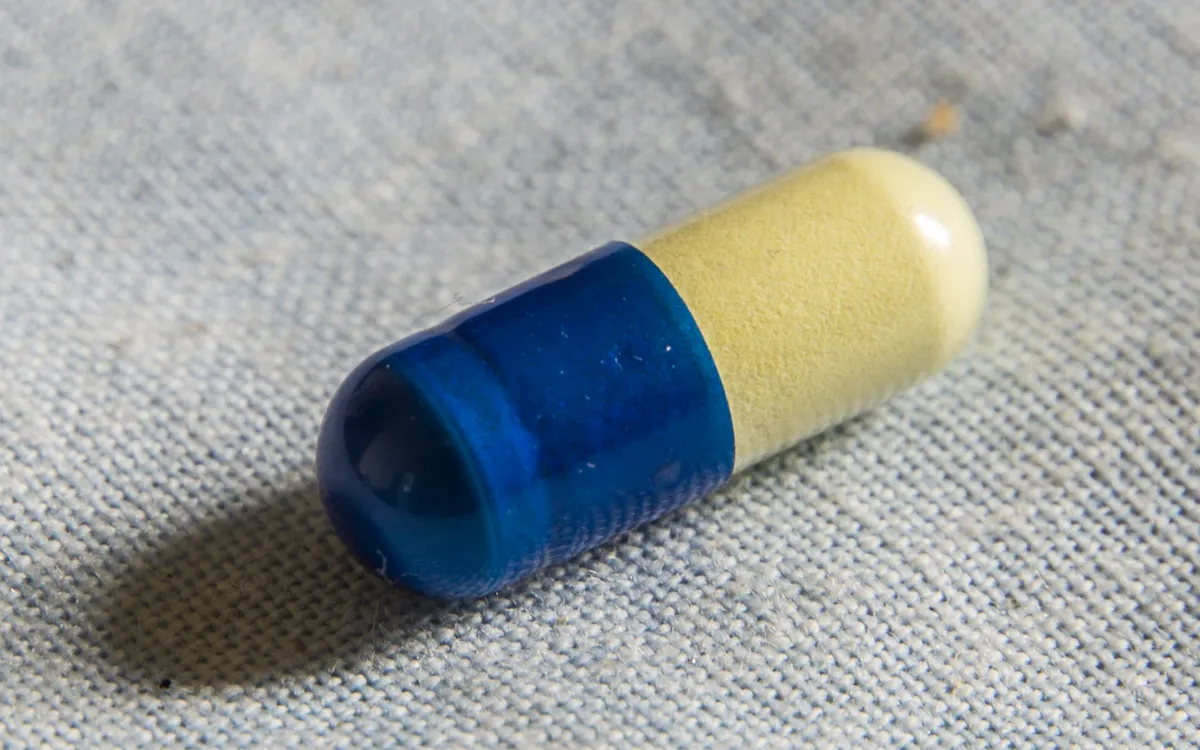
Today I want to show you this picture of a doxycycline pill that was taken 8 years ago. We carried hundreds of these pills during 2018-19 while cycling up the west coast of Africa, from Namibia to Morocco through many countries along the way. Bell (then Evan) and I each took one pill daily with dinner, for maybe a year, to protect ourselves from malaria.
Our initial batch of pills was sourced in Windhoek, where a Zimbabwean doctor, also a keen traveller, grilled me about our itinerary so that he could decide how many pills to prescribe us. I know this because I wrote it down in a digital journey entry in Day One, the app we were using at the time. The 12 entries in Day One that mention doxycycline are also why I can tell you that I knew that taking the antibiotic for a long time was "controversial."
We started taking it in November in northern Namibia, where the aridity that limits mosquitos gives way to a lushness near the southern Angola border. I was nervous about taking doxycycline, because of the increased sun sensitivity. There was the occasional tingly mouth ("didn't take it with enough water tonight") and apparently I wasn't supposed to take it with dairy, which I did sometimes anyways.
The sun thing was real. I burned through my long-sleeved clothes. I applied SPF 50 and it would sweat off my uncovered extremities. I burned the sunny side up of my hands in new ways, making them mottled. I eventually bought black stretchy cotton gloves, the kind you can get at the dollar store in Canada. These had a football team logo on them and I started cycling with them after I'd caught and recovered from malaria.
By December we were in Angola, where this photo of the pill was taken. Before Christmas I had malaria, the bad kind, confirmed by microscopy, with two types of parasites living their life cycles inside of me.
So of course when I think about doxycycline I think about getting malaria. When I think about getting malaria I think about the paradox of feeling so scared and being in a legitimately vulnerable position, while at the same time having so many layers of resilience there to catch me.
I have not forgotten the feeling I had walking down the main road near our room in N'Zeto, leaving the market and heading home. I felt so strange in my body. I knew that something different was wrong with me. But I felt nervous and shy to be assertive and act quickly. But I remember thinking that if I had malaria and waited even a day to get treatment, I could die. There were other risks. If N'Zeto hadn't had a clinic to test me or the treatment to cure me, I also could have died if we'd gotten on a minibus or hitchhiked and things had proceeded too slowly.
The resilience I am referring to includes many things: the courses of treatment medication we had with us. (Which may or may not have been the appropriate type for these parasites.) We could have paid easily for any transport to another town, or a city, or another country. I had a partner who waited on me hand and foot. I could just lie in bed without dependents or a job. I let the cool air of the old air conditioner roll over me and I ate buns and drank juice and slept day and night when I wasn't terrorizing the ensuite bathroom.
Now being on the bicycle again, something that amuses me is how many pills we have with us. No doxycycline, but there are others in its place, and more. Supplements, probiotics, Bell's hormones and the associated medical paraphernalia that requires. On top of this, a big first-aid kit, which I believe even includes a few courses of emergency malaria treatment. And on top of that, the memory in our bodies of thousands of dollars' worth of vaccinations renewed last year.
I was on a flight recently (with a fresh batch of pills, yes). I watched the movie Twentieth Century Women. A woman, her son, a man, and a woman are cohabitating in a ramshackle California house in the 60s or 70s. The latter woman is doing a photography project where she photographs the items of her life one by one. Like her underwire bra, that kind of thing.
In our shared Lightroom catalogue of images, over 35,000 of them, there's a dozen or so that are in the style of the doxycycline pill at the top of this post. They are images of items that bring up visceral memories for me. Each individual item was extremely well-used. Most items are covered in a patina of grime and the photographs show this in great detail because of the magnification and bright natural light.
They're like a museum exhibit of a chapter of a life. If a room was devoted to things I put into my body, doxycycline would be included. Alongside Bacardi Limon, sugar, bupropion, mushrooms, lentils, and coffee.
Malaria was scary and gross. I would take doxycycline again if it meant meaningfully reducing my chances. You can't reduce them to zero. My theory is that a particularly violent bout of diarrhea earlier in Angola had led to poor doxycycline absorption, leaving me vulnerable. I was then, and am now, only average when it comes to applying insect repellent.
My experience is also incredible to me because I was able to get immediate testing, microscopy diagnosis, and treatment, for a few dollars (maybe $20 CAD total?) in a small town in Angola. And yet hundreds of thousands of people die each year from malaria. A lot of them are kids living in African countries (like Angola). It can be impossibly hard for the families to scrounge together a few dollars to pay for treatment or to pay for the treatment to go to places like N'Zeto where the treatment is available. When people are wanting to learn more about malaria I generally recommend the Against Malaria Foundation, as their Web 1.0 website is easy to navigate and understand.